
Measuring a Press Fit from the Inside: Precisely Determining Wheelset Contact Pressure
A railway wheel sits on its axle with an extremely tight interference fit. Traditionally, a wheelset press measures the applied force during assembly to assess joint quality. The catch: This force depends heavily on lubrication.
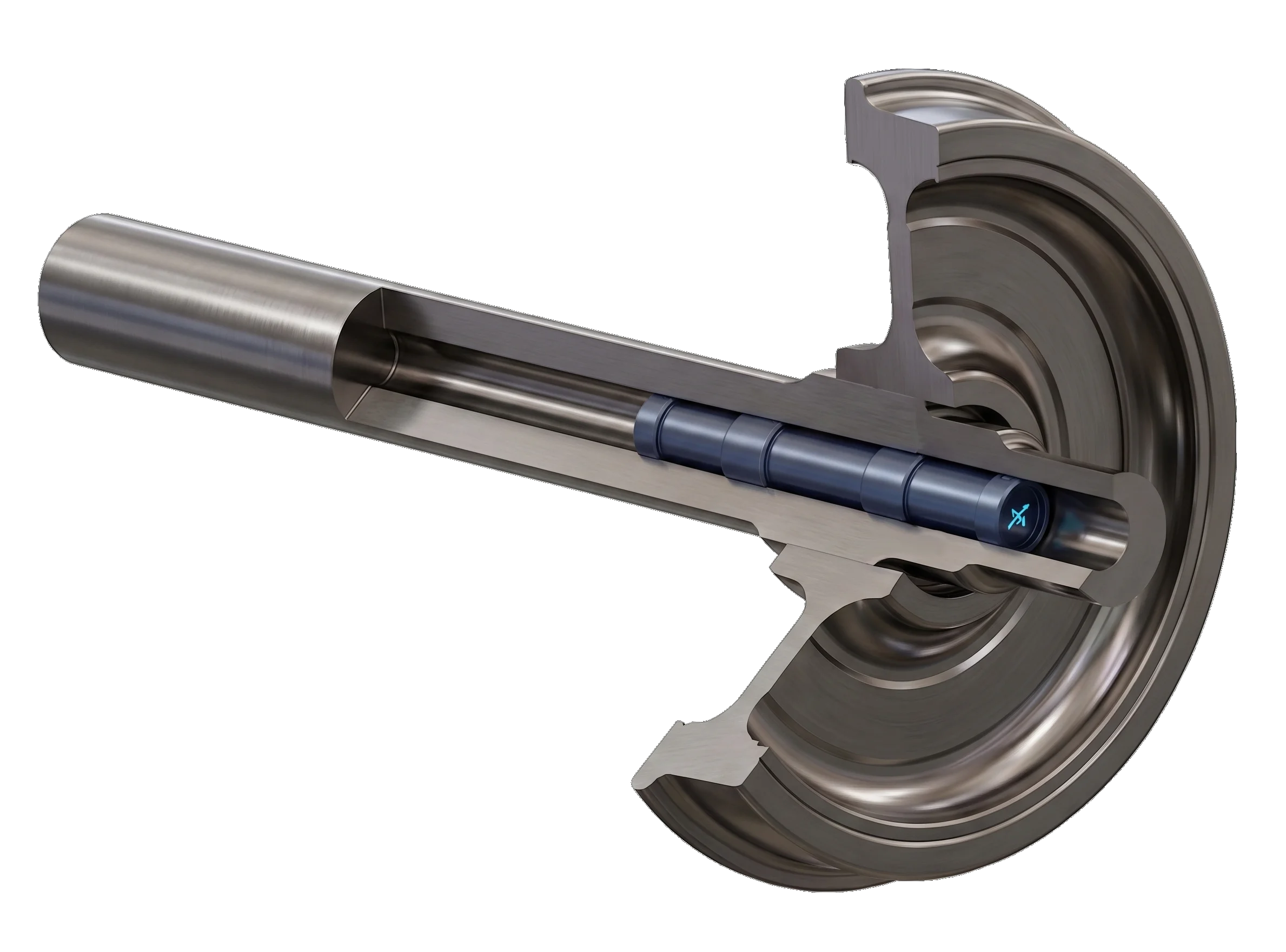
However, the true strength of the wheel connection is determined solely by the contact pressure (fitting pressure). Until now, this could not be measured directly on an assembled wheelset. The Zyglox Hollow Shaft Sensor (HSS) in the axle bore fundamentally changes this, making invisible strength measurable.
Why the Wheelset Press Doesn't Tell the Whole Story
The bore of the wheel is about a tenth of a millimeter smaller than the axle seat. When the hydraulic press pushes the wheel on, this interference generates enormous pressure at the seat. This pressure, combined with friction, prevents the wheel from coming loose or shifting during operation.
The force required for pressing is generated by friction on the contact surface and is calculated using the formula $F = \mu \cdot \oint p \cdot dA$.
If the press-fit diagram drops or falls outside the tolerance range, the wheelset is rejected as scrap. However, the great unknown in this equation is the coefficient of friction $\mu$. With the exact same interference and identical contact pressure, the required press force can vary by a factor of 2.5 depending on lubrication.
This means: Press force alone cannot reliably distinguish a perfectly fitting interference fit from a poorly lubricated but otherwise defective connection.
The decisive factor for safety is the actual contact pressure at the seat—a value the press does not display. Once the wheel is mounted, the contact surface becomes inaccessible to external measuring devices.
This is where the Zyglox Hollow Shaft Sensor (HWS) comes in. It is placed directly inside the axle bore. The interference of the wheel compresses the axle inward, generating a measurable hoop stress on the bore surface.
Measurement Independent of Friction: While the conventional press-fit force fluctuates significantly depending on friction, the hoop stress in the bore provides a clear, friction-independent value.
Maximum Load Visible: The stress reaches its peak below the center of the seat (approx. −170 MPa at maximum interference).
Dynamic Monitoring During Assembly
By analyzing the press-fit stroke, the assembly process can be precisely tracked. As the wheel slides onto the seat, the contact area continuously grows. After about two-thirds of the distance, a relief groove in the wheel bore passes over the beginning of the seat, which briefly and measurably interrupts the contact. Every single step is captured precisely by the sensor.
Your Advantages at a Glance:
Constant Conversion: The average factor of 0.54 applies across the entire range with a maximum deviation of only ±1.2%.
Micrometer Precision: A sensor with an accuracy of 1 MPa determines the radial interference to an accuracy of approximately 0.7 µm (the stress in the bore changes by 1,407 MPa per millimeter of interference).
Retrospective Quality Control: The actual interference achieved can be determined at any time from the measured value—a parameter that was previously lost forever if the wheel and axle were not precisely measured before assembly.
With the Zyglox Hollow Shaft Sensor, you can verify the fitting pressure of a wheelset not only during assembly but at any time after mounting. This guarantees maximum safety and absolute transparency in the quality assurance of your interference fits.
| Interference | Measured Value in Bore | Pressure at Seat | Ratio (Factor) |
|---|---|---|---|
| 0.050 mm | -65.7 MPa | 36.2 MPa | 0.551 |
| 0.075 mm | -100.9 MPa | 54.9 MPa | 0.544 |
| 0.100 mm | -135.9 MPa | 73.5 MPa | 0.541 |
| 0.125 mm | -171.3 MPa | 92.2 MPa | 0.539 |